Sleep and muscle recovery. Why proper rest is a part of a training?

Sets done. The last rep barely went up. Protein drunk. The shaker bottle lands in your bag, and you leave the gym with the feeling of a job well done. Can the workout be considered finished? Not quite. Sleep is one of the key elements of muscle recovery, because that is when the body steps up anabolic processes, muscle protein synthesis and tissue repair after exertion. Your body still has plenty of work to do, and it carries out a large part of that work when you are no longer doing anything. Muscle recovery is a process that largely takes place outside the training room. Between sets and the next session, something happens without which even the best training plan won’t deliver the expected results.
Published at:
Oct 22, 2026Updated at:
Nov 2, 2026Rate:
Table of content
The most important part of training happens outside the gym
Intense training is a stimulus. Important, necessary, but still only a stimulus that triggers the body’s adaptive processes. Muscles don’t grow during squats, but afterward, once they are given time, nutrients and rest. More sessions per week doesn’t necessarily mean better results. Without enough time to rebuild, the body can’t keep up with adaptation, and instead of progress you get fatigue, stagnation and a growing risk of overload. It’s a bit like trying to bake a cake in an oven that never gets a chance to heat up.
That is why building muscle mass and endurance rests on three equal pillars: training, nutrition and sleep. None of them works in isolation. You can have a perfectly written training plan and precisely selected macronutrients, but if you regularly sleep five hours, your body simply has no time to carry out its part of the deal. This is a text for physically active people, both strength and endurance athletes, who want to better understand how sleep translates into recovery, results and training effectiveness. Sleep and muscle recovery is a topic that in the world of sports and fitness is sometimes treated as an afterthought. And that’s a pity, because a lack of adequate sleep can slow down rebuilding, weaken performance, limit adaptation and increase the risk of injury.
In this article we will look at what exactly happens to your muscles during sleep. We will check how sleep affects hormones (testosterone, growth hormone and cortisol) as well as strength, endurance and injury risk. We will also say why chronic sleep deprivation can sabotage your training goals and what to do to improve recovery during sleep. The good news? The most enjoyable part of the entire training plan is also one of the most important.

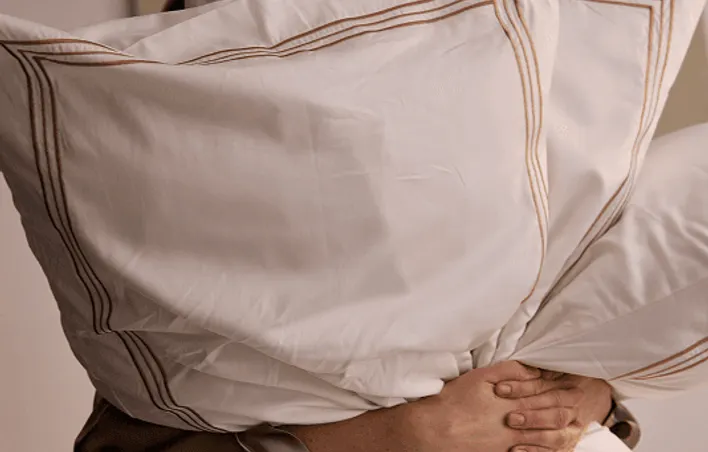
600 Satin Gold Border Pillow / Italian luxury
Soft and smooth. 600 TC cotton sateen and a distinctive border give it a subtle, elegant appearance. Inspired by the bed linen found in Westin hotels.
Check it outWhat does muscle recovery after training involve?
What happens to muscles during physical exertion?
Every workout is controlled stress. Your muscles work under load, use up glycogen, accumulate fatigue metabolites and undergo changes in fiber structure. With intense or new exercises, micro-damage may appear: those tiny disruptions of muscle tissue that remind you of themselves the next day when you walk down the stairs. But note: micro-damage is not a necessary condition for muscle growth. Building muscle mass also occurs when you don’t feel the characteristic soreness. The scale of changes depends on the intensity, volume and type of training: a heavy strength session triggers different reactions than light endurance training.
How does the body rebuild after exertion?
The main mechanism of rebuilding is muscle protein synthesis, or MPS. It is a process in which the body uses amino acids from the diet, and this depends on essential amino acids such as leucine, for muscle repair and to build up muscle structures. The training stimulus triggers MPS, and proper nutrition, primarily protein, provides the building material. This process lasts from several to even dozens of hours after the training session, depending on your level of advancement and the nature of the effort.
In parallel, the body rebuilds glycogen stores in the muscles and liver, which requires carbohydrates and time. The nervous system also adapts: recruitment of motor units, coordination and movement efficiency improve. Rest after training is not a break from work, but the moment in which the body carries out the actual part of the program. Without this rest, the next training session loses its point, because the body won’t have time to adapt to the previous stimulus.
How long does muscle recovery last?
There is no single universal recovery time, and it’s important to remember that. A high-volume, heavy leg workout may require 48-72 hours of rest, while a lighter arm session will let you return to exercise sooner. Experienced athletes recover more efficiently than beginners, because their bodies are better adapted to loads. Age, sleep and nutrition also shift this scale, sometimes significantly.
And here comes the trap: delayed onset muscle soreness can fade before you are fully ready for the next load, and low-intensity movement may reduce post-workout stiffness without meaning recovery is complete. You may not feel sore muscles while recovery processes are still ongoing. That is why planning rest days between training sessions is a condition for the next workout to actually translate into progress. Sleep and muscle recovery is a topic we will return to in a moment, but it’s already worth remembering: rest after training is part of training. The more pleasant part.
Sleep and muscle recovery: what happens in the body during sleep?
You already know that muscle recovery is a complex process involving protein synthesis, glycogen rebuilding and nervous system adaptation. Now it’s time for the question: why does sleep play such an important role in all of this? The answer is simpler than it might seem. When you fall asleep, your body doesn’t switch off; it switches mode. Physical activity drops, body temperature lowers, and metabolic and regenerative processes gain conditions favorable to intensive work. Sleep is a period of heightened physiological regulation: from hormonal balance to muscle protein synthesis. Recovery, however, is not reserved exclusively for nighttime hours: it also occurs during the day, especially with proper nutrition and rest. Sleep simply creates an exceptionally favorable environment for it.
How does sleep support muscle rebuilding and adaptation?
During sleep the body intensifies anabolic processes, including muscle protein synthesis, which is key for building muscle mass and repairing tissues after exertion. The role of sleep in sport, however, goes far beyond the muscles alone. Sleep supports the restoration of physiological balance: it regulates blood pressure, supports immune function and lets the nervous system “process” the training stimuli of the past day, while daytime active recovery between sessions can also support muscle repair by increasing blood flow and nutrient delivery. This doesn’t mean that a single night decides everything. Muscle recovery is a continuous process, and sleep is one of its pillars, alongside nutrition and properly planned rest after training.
Deep sleep and body recovery
Every night you go through several sleep cycles, each lasting about 90 minutes and including NREM and REM phases. The N3 phase, i.e. slow-wave (deep) sleep, is particularly interesting from the perspective of physical recovery. It is in this phase that the greatest nighttime secretion of growth hormone is observed, a substance supporting tissue repair and metabolism. In deep sleep the body also enters a greater state of relaxation, and sleep lowers cortisol levels. It would be tempting to state that all muscle rebuilding takes place in the deep phase. Reality is more complex. Regenerative processes involve different phases of the cycle, and trying to reduce them to one stage is an oversimplification. The body needs the full spectrum of sleep, not just one fragment.
The REM phase and nervous system recovery
The REM (rapid eye movement) phase, in turn, is a time of intense brain activity. If you’re learning a new exercise, working on your snatch technique or perfecting coordination on the field, the REM phase probably plays a significant role in consolidating these motor skills. Research points to its importance in memory consolidation and learning, though the exact mechanisms are still being studied. For athletes learning new movement patterns this is important information: sleep and muscle recovery is not only a matter of muscle tissue, but also of the nervous system, which controls every movement.
The full sleep cycle: why not to optimize one phase?
The internet is full of advice on how to “increase the amount of deep sleep” or “lengthen the REM phase.” It sounds tempting, but the body has its own plan. Complete, uninterrupted NREM and REM cycles work together: each phase serves a different function, and together they create the conditions for full recovery. Instead of trying to hack sleep architecture, it’s better to take care of what you really have under control: a regular bedtime, an adequate number of hours and conditions conducive to uninterrupted rest. It’s less flashy than biohacking, but definitely more effective.
Sleep and hormones: how do testosterone, growth hormone and cortisol affect recovery?
Hormonal balance is one of those topics that in the fitness internet can take on a life of its own. Testosterone: the king. Growth hormone: the savior. Cortisol: public enemy number one. Reality is a bit less dramatic. Each of these hormones plays an important role in muscle recovery and training adaptation, but none of them works in a vacuum. And sleep and muscle recovery is a topic in which hormones are an important, though not the only, piece of the puzzle.
Testosterone, sleep and muscle development
Testosterone participates in many processes: from muscle protein synthesis, through bone tissue metabolism, to mood regulation. Its daily secretion has a clear rhythm: the peak occurs in the morning hours and is closely linked to the quality of nighttime rest. Studies conducted on young men showed that limiting sleep to just 5 hours for a week can lower testosterone concentration by as much as 10-15%. That is a considerable drop, comparable to the effect of over a decade of aging. It’s worth remembering, however, that testosterone level is not the only factor determining training results. Building muscle mass depends on many variables: training, nutrition, overall recovery and genetics. You can read more about this relationship in the article: Testosterone and Sleep: How Does Sleep Deficiency Affect Hormonal Balance?.
Growth hormone: why does deep sleep matter?
Growth hormone (GH) is another hero of the night shift. It is estimated that up to 75% of its daily secretion occurs during slow-wave sleep, the deep phase we wrote about earlier. GH participates in tissue metabolism, supports repair processes and regulates fat metabolism. Sounds like the perfect supplement? In a way, with one reservation. Greater secretion of growth hormone does not automatically translate into greater muscle gain. The body is not an equation in which it’s enough to turn up one variable to change the result. The role of sleep in sport is rather to create conditions in which all regenerative processes can run smoothly, and not to maximize a single parameter.
Cortisol and recovery after training
Cortisol has terrible PR. In fitness discussions it usually appears as the hormone that “eats your muscles” and sabotages your progress. Meanwhile, cortisol is a natural and essential element of the body’s response to physical exertion and stress. Without it, your body would not mobilize energy during training. The problem begins when cortisol level is chronically elevated, for example as a result of chronic sleep deprivation, constant psychological stress or lack of rest after training. Then rest after training becomes insufficient, and muscle recovery may be hindered. You will find more on this topic in the article: Cortisol and Sleep: Why Doesn’t Stress Let Us Rest?.
Balance, not optimization of individual hormones
Instead of looking for ways to “hack” testosterone or growth hormone levels, it’s worth looking at the matter more broadly. Proper hormonal balance is the result of balance between training load and rest, not a one-time intervention. Regular, sufficiently long sleep. Sensibly planned training. Adequate nutrition. That doesn’t sound as exciting as “one simple trick for testosterone,” but it works decidedly better. Your hormones don’t need a revolution. They need conditions in which they can simply do their job.
What happens to muscles when you sleep too little?
Does lack of sleep slow down muscle recovery?
Limiting sleep can affect the pace of regenerative processes, including muscle protein synthesis, which is one of the key mechanisms of rebuilding after training. Research indicates that chronic sleep deficiency disrupts the body’s hormonal and metabolic environment, potentially slowing adaptation to exertion. It is worth distinguishing two situations, however. One sleepless night is not the same as weeks of systematic sleep deprivation. The body is able to compensate for a single incident. The problem begins when 5 hours of sleep becomes your norm rather than the exception. Muscle recovery is a continuous process, and it needs continuous support.
Does sleep deprivation worsen training results?
In short: yes, though the scale depends on what you do in training. Fatigue lowers maximal strength, endurance and reaction speed. It worsens motor coordination and concentration. And on top of that, it increases the subjective perception of effort: the same workout after a poor night simply feels harder. With simple, repetitive exercises the effects may be less noticeable. But with movements requiring precision, balance or quick decisions, the difference can be clear. Rest after training begins with what happens before it. And the role of sleep in sport is not limited to recovery: it also affects how well you are able to train at all.
Lack of sleep and injury risk
Observational studies point to a link between sleep deficiency and a higher risk of sports injuries. The mechanism is fairly intuitive: worse attention, slower reaction time, reduced coordination: that’s not a recipe for a safe workout. One frequently cited study on young athletes showed that those sleeping less than 8 hours had a significantly higher risk of injury. Does this mean that good sleep guarantees avoiding injury? No. Injuries have many causes. But systematic sleep deprivation is a risk factor that is relatively easy to reduce.
Can you build muscle on only 5-6 hours of sleep?
Building muscle mass on 5-6 hours of sleep is probably still possible, provided that training and nutrition are properly planned. The body doesn’t switch off adaptive processes after crossing some magic threshold. But the pace and efficiency of these processes may be lower. Less sleep potentially means a worse hormonal environment, slower recovery and greater fatigue in subsequent workouts. There is no single minimum number of sleep hours that guarantees muscle gain. There is, however, a simple relationship: regular sleep deficiency systematically makes it harder for the body to adapt. Long-term habits matter more here than individual nights. One lost night before an exam won’t undo your progress. Months of chronic sleep deprivation are a different story.
How many hours should you sleep and when should you train to support recovery?
How much sleep does a physically active person need?
The standard recommendation for adults is 7-9 hours of sleep per day. If you train regularly, your needs probably fall in the upper part of this range, and some athletes need even more. But note: the number of hours alone isn’t everything. Regularity of bedtime and wake-up time is sometimes more important than arithmetic. In people with sleep disorders, melatonin may improve sleep quality, but it does not replace the basics of sleep hygiene. The body likes predictability, because the circadian rhythm supports falling asleep and recovery. Do you go to bed every day at 11:00 p.m. and get up at 6:30 a.m.? Your biological clock will thank you with better sleep quality and more efficient recovery.
Do you need to sleep longer after a hard workout?
Leg day. You know what we’re talking about. After a really demanding training session, extra sleep can be helpful, and there’s nothing strange about that. A greater load means more recovery work to be done. You don’t have to set your alarm based on a training volume calculator, however. Go by your subjective well-being: if in the morning you feel like you spent the night at an airport rather than in bed, your body probably needs more rest. Sleep quality matters here at least as much as its length. Extending sleep after very heavy loads may also have a beneficial effect on later performance and partially limit the effects of periodic sleep deficiency.
Does a nap after training help recovery?
A short nap of 15-20 minutes after training can improve alertness and well-being. It’s particularly useful when you train in the morning or at noon and feel an energy dip during the day. There is one caveat, however: a nap does not replace regular nighttime sleep. It’s more the espresso of recovery: a quick boost, not a full meal. So as not to make falling asleep harder in the evening, it’s worth planning a nap before 3:00 p.m. Later, your body may have trouble distinguishing whether it’s still a short rest or already sabotage of nighttime sleep.
Evening training: does it really ruin sleep?
The popular advice goes: don’t exercise before bed. Reality is more nuanced. Reactions to evening physical activity are individual and depend on the intensity of the effort and the time between training and going to bed. Some people fall asleep without a problem after an evening workout, others need a longer break to wind down. If the only available time for the gym is 8:00 p.m., don’t give up training in the name of a theoretically optimal schedule. The role of sleep in sport is enormous, but building muscle mass also requires regularity of exercise.
The best training time? The one that doesn’t steal your sleep
Chronotype, i.e. your natural tendency to be a “lark” or an “owl,” affects when you feel most ready for exertion. But the best training time is most often the one you can maintain without shortening your sleep. Do you get up at 5:00 a.m. for training and then scroll your phone until 11:00 p.m.? The math doesn’t add up. Sleep and muscle recovery is a system of connected vessels: by shortening one, you limit the other. Regularity and common sense beat any theoretically perfect plan.
How to speed up muscle recovery during sleep? 7 practical rules
You already have knowledge about what happens in the body during sleep and why rest after training is not an option but a necessity. Time to get specific. The seven rules below are not a wish list; they are elements you can implement today. None of them requires specialized equipment or a supplement budget. They do require one thing: treating sleep as part of the training plan, not as what’s left over after the rest of the day.
1. Plan an adequate amount of sleep
Do you put workouts in your calendar? Do the same with sleep. Set regular bedtimes and wake-up times, on weekends too. If you train intensely, your need for rest increases. An extra 30-60 minutes of sleep during periods of heavy training load is not laziness, it’s strategy. Chronic sleep deprivation, even by an hour a day, accumulates from week to week and gradually undermines recovery before you even notice a drop in form. Treat sleep like a set you’re not allowed to skip.
2. Take care of proper nutrition
Muscle recovery needs building material. For people who train, the recommended protein intake is 1.6-2.2 g per kilogram of body weight per day, spread across several meals, including the last one before sleep, preferably light and containing casein protein or a casein-based protein supplement. Carbohydrates help rebuild glycogen stores, and consuming them in the evening increases plasma tryptophan concentration and may help improve sleep quality; protein rich in this amino acid works similarly. A light, easily digestible post-workout meal with such a protein source and a moderate portion of carbohydrates works best as a combination for workout recovery when you eat protein-rich foods within about 90 minutes after exercise, while overall calorie intake should still match training demands to support repair, hormone balance, brain function, and bone health. Rehydrating with 16-20 fl oz of water after a workout supports recovery, adequate hydration improves fluid retention during recovery, and dehydration can raise the risk of muscle cramps during exercise. Supplementation? It can supplement the diet, but it will replace neither nutritionally complete meals nor seven hours of sleep. No capsule will make up for what you don’t provide your body on the plate and in bed, especially since an overly fatty last meal can burden the digestive system and lead to worse sleep quality.
3. Avoid excessive training load
More isn’t always better. Plan recovery days with the same care with which you plan training days, and schedule a full rest day about every 7 to 10 days to support overall health. Increase volume and intensity gradually; the 10% per week rule is a reasonable starting point. If you notice persistent fatigue, a drop in motivation, worsening results, sleep problems, or nagging soft tissue issues, your body is sending signals. React to them before exhaustion turns into overtraining; overtraining syndrome has been reported in about 60% of elite athletes. Rest after training is not a waste of time; it’s an investment in the next session.
4. Limit caffeine in the second part of the day
An afternoon coffee seems harmless, but the half-life of caffeine is about 5-6 hours. That means that at 9:00 p.m. half of that dose is still circulating in your body. Sensitivity to caffeine is very individual: some people fall asleep without a problem after an espresso at 5:00 p.m., others feel the effects of a cup drunk at lunchtime. It’s worth testing your own time limit. For two weeks, limit caffeine to morning hours and see whether your falling asleep changes. The results may surprise you. Caffeine consumed too late can negatively affect falling asleep and, indirectly, muscle recovery.
5. Introduce an evening wind-down ritual
The body has no “night mode” switch; it needs a signal that it’s time to move into rest mode. Calm activities before sleep help send that signal. Limit exposure to blue light and stressful stimuli for an hour before sleep, because this supports sleep quality. Instead of scrolling the news, try a few minutes of breathing exercises, light stretching or simply reading; dynamic stretching is usually better earlier around training to improve performance and support recovery, while foam rolling is a popular optional way to ease post-activity soreness before the wind-down period. The role of sleep in sport begins not at the moment you close your eyes, but at the moment you consciously slow down. The ritual doesn’t have to be complicated; it’s enough that it’s repeatable and focused on stress reduction.
6. Take care of bedroom conditions
A temperature of 18-20°C, darkening and silence are the three pillars of an environment conducive to deep sleep. A comfortable mattress, a well-fitted pillow and bedding materials that are pleasant to the touch make a difference you will feel in the morning. It’s not about luxury for luxury’s sake. It’s about making sure nothing disturbs your rest, neither street light nor a pillow you’re fighting with for a comfortable position. Building muscle mass requires consistency in the gym. But it also requires consistency in the bedroom.
7. Observe the quality of rest, not just the number of hours
A smartwatch will show you a chart of sleep phases. But it’s your morning well-being, your level of daytime sleepiness and your subjective readiness for training that tell you more about the quality of recovery than a colorful diagram on your wrist. If you wake up tired despite a “sufficient” number of hours, something needs adjusting: maybe bedtime, maybe bedroom conditions, maybe training load. Sleep and muscle recovery is a relationship best assessed by effects, not statistics. Listen to your body. It doesn’t need an app to tell you the truth.
Sleep comfort as part of recovery: does the pillow matter?
Why is a comfortable sleeping position important?
You can plan the perfect 8 hours of sleep, darken the bedroom and turn off your phone at 9:00 p.m. And then you wake up at three in the morning because something is digging into your neck. An uncomfortable pillow can effectively disrupt rest after training: it forces position changes, shortens deep sleep phases and makes you feel in the morning as if you hadn’t slept at all. A comfortable position of the head and neck is not a matter of luxury. It’s a matter of making sure nothing prevents your body from doing what it does best at night: muscle recovery and restoring balance.
Matching the pillow to the position in which you sleep has practical significance. A side sleeper needs a different height and resilience than someone who falls asleep on their back. A pillow that’s too flat won’t provide adequate neck support. One that’s too high will force an unnatural head position. In both cases the effect is the same: you wake up, you toss and turn, and the subjective quality of rest drops. It’s not about the pillow being expensive. It’s about it being well chosen.
What distinguishes Rovelli pillows?
Rovelli pillows in the 50 × 90 cm size were created with proper support in mind, not marketing promises. The polyester filling was carefully selected for resilience and the ability to regain shape. It is the same type of filling used in premium hospitality, where a pillow must prove itself night after night, for different people and different sleeping positions. The cotton fabric cover is pleasant to the touch and breathable. The construction is designed so that the head and neck have support, without excessive hardness and without sinking after a few weeks of use.
Recovery deserves the right conditions
In the gym you take care of technique, load and every rep. And what about the place where you spend the next eight hours? The role of sleep in sport is well documented, but sleep itself is only the beginning. How you sleep matters too. A well-chosen pillow won’t do your training for you. It won’t increase protein synthesis, raise testosterone or add kilograms of muscle mass. Your body does the rest. But it can make nighttime rest simply more comfortable: no waking up, no searching for a comfortable position, no stiff neck in the morning.
And recovery definitely deserves good conditions.

FAQ
Why doesn’t more training per week always translate into better results?
Training is a stimulus that triggers adaptation, but without adequate rest the body has no time to rebuild muscle. Sessions that are too frequent, combined with insufficient sleep and nutrition, can lead to fatigue, stagnation and overload instead of progress.
Does the disappearance of delayed onset muscle soreness mean muscles are fully recovered?
No. The disappearance of muscle pain (DOMS) is only one signal: muscle protein synthesis and glycogen rebuilding can continue for many hours after the discomfort subsides. Full readiness for the next load depends on the type of training, intensity, sleep and nutrition.
In which sleep phase do muscles recover?
Muscle recovery is not limited to one phase. Deep sleep (N3) is associated with the greatest nighttime secretion of growth hormone, and the REM phase supports the nervous system and consolidation of motor skills. The body needs complete, uninterrupted NREM and REM cycles for regenerative processes to run optimally.
Does limiting sleep really lower testosterone levels?
Yes, studies have shown that shortening sleep to 5 hours per day for just a week can lower testosterone concentration in young men by 10-15%. Testosterone, however, is only one of many factors affecting recovery, and the long-term quality and regularity of sleep are of key importance.
Can you build muscle mass while regularly sleeping only 5-6 hours?
Building muscle on 5-6 hours of sleep is probably still possible, but potentially slower and less effective. Regular sleep deficiency worsens the hormonal environment and slows recovery, so long-term sleep habits matter more than individual shorter nights.
Can a nap after training replace nighttime sleep in terms of recovery?
No. A short nap (15-20 minutes) improves alertness and well-being, but it does not replace full nighttime sleep, which is key for deeper regenerative processes. A nap is worth planning before 3:00 p.m. so that it doesn’t make falling asleep in the evening harder.
How to limit caffeine so it doesn’t worsen sleep quality after training?
The half-life of caffeine is about 5-6 hours, so a cup drunk at 3:00 p.m. is still active at 9:00 p.m. It’s worth limiting coffee to morning hours for two weeks and observing whether falling asleep improves. Sensitivity to caffeine is individual, so testing your own time limit is key.
Does the pillow affect the quality of muscle recovery after training?
A pillow does not directly affect regenerative processes such as protein synthesis or hormonal balance. It can, however, affect sleep comfort: an uncomfortable pillow can wake you and force position changes. Well-matched height and resilience help you sleep without disruption, and uninterrupted sleep supports recovery.
Summary
Muscle recovery mainly takes place outside the gym: sleep, nutrition and load planning are three equal pillars of building form.
- Deep sleep (N3) and the REM phase serve distinct roles: the former is responsible for growth hormone secretion and tissue rebuilding, the latter for consolidation of motor skills. Complete, uninterrupted cycles are key, not maximizing one phase.
- Hormones depend on the balance between training and rest: testosterone, growth hormone and cortisol respond to sleep quality; trying to optimize individual parameters without caring for the whole is ineffective.
- Sleep deficiency doesn’t block muscle gain, but it slows it: building mass on short sleep is possible, but less effective. The risk of injury also rises and training results decline in the longer term.
- 7-9 hours of sleep, regularity and matching your chronotype are the practical minimum for active people: naps can supplement nighttime rest, and evening training doesn’t have to disturb sleep if it’s properly planned.
- Specific habits supporting recovery: an adequate portion of protein and carbohydrates after training, limiting caffeine in the second part of the day, an evening wind-down ritual and a comfortable position of the head and neck during sleep.